
4 politico News
Three months after it began, the story of President Donald Trump’s siege of Minnesota has been one told with violent imagery. Masked men smashing windows and dragging women from their cars. A smiling mother behind the wheel of her SUV, a rattling of gunshots, a dashboard sprayed with blood. Outraged Americans shouting at government agents amid clouds of choking gas. An ICU nurse prone on the pavement.
The images told the story of the streets, but even as the administration moves to wind down its historic immigration crackdown in the Twin Cities, announcing a drawdown of operations this week, another story unfolds behind locked doors and drawn curtains. It is the story of tens of thousands of families living in terror, too afraid to venture into their communities for life’s most basic necessity: food.
In response to unprecedented conditions, an underground army coalesced to bring sustenance to families in hiding.
On the ground in Minneapolis, St. Paul, and communities across the state, this is the reality that has kept people up at night.
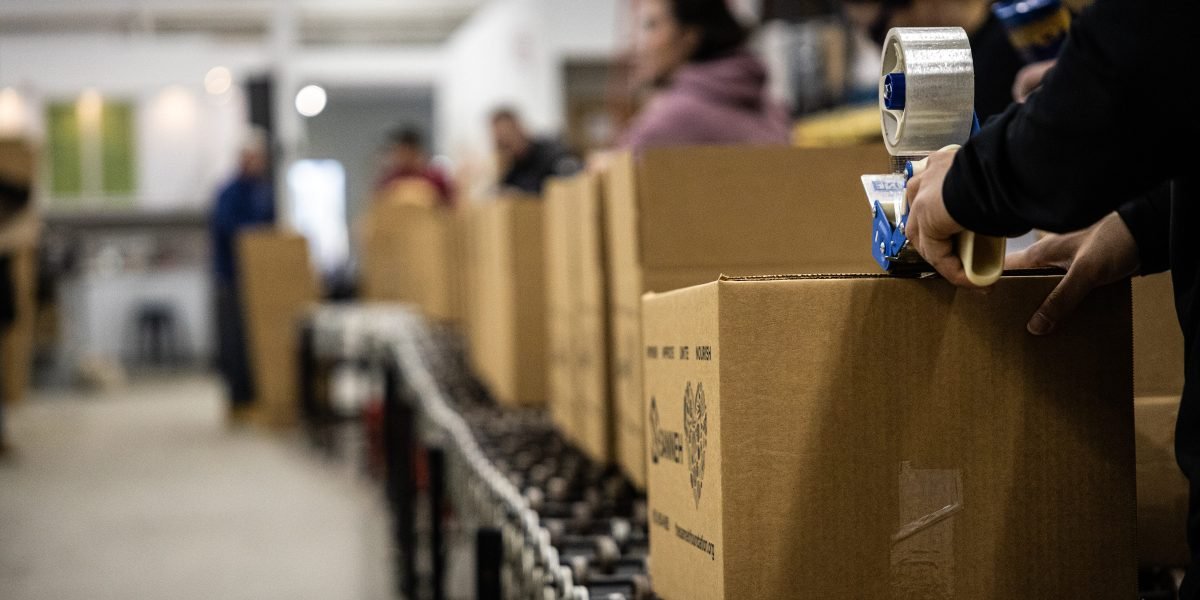
In response to unprecedented conditions, an underground army coalesced to bring sustenance to families in hiding. The Intercept was recently invited inside a nondescript Minneapolis warehouse to observe their operations in action.
It was delivery day, which meant volunteers stuffing boxes with oatmeal and spaghetti, flour and chicken, rice, tomato sauce, vegetable oil, and more. Six hundred boxes were prepared the day before. Hundreds more would be added by day’s end. Inside, volunteers left notes telling recipients they were missed, and that they hoped to see them again soon.
The packages were loaded into a fleet of station wagons and SUVs. Alongside the food was baby formula, medication, and other essentials. Many of the vehicles were driven by teachers taking supplies to the families of students who haven’t been to class for weeks. They would proceed carefully on their mission, one eye on the rear-view mirror as they ferried their precious cargo.
As the latest in a series of dragnets targeting Democratic-led cities and states, Minnesota’s “Operation Metro Surge” saw 3,000 U.S. Immigration and Customs Enforcement and Border Patrol personnel deployed in early December. Across the state, immigrant families went into hiding.
Joe Walker, director of nutritional services at the Sanneh Foundation, a local charity that operates a mobile food shelf in the Twin Cities, saw the impact immediately.
Not only were families no longer appearing to receive food, Walker told The Intercept, delivery vehicles were being followed, and distribution sites were being staked out by suspected federal agents. To volunteers on the ground, it felt as though the government was weaponizing hunger to root out a foreign enemy.
“We have to play by all the rules,” Walker said. “They don’t.”
Building an Aid Operation
Guiding operations at the warehouse visited by The Intercept was a 24-year-old soccer coach named Mu Thoo. Thoo spent his first eight years in Thailand and the rest of his life in the Twin Cities. He went to work for Walker’s mobile food shelf in 2022.
As part of the immigrant community, Thoo acknowledged that Metro Surge upended life for countless families.
“It’s scary,” Thoo told The Intercept, but, he added, “I don’t believe in living in fear. People are going to need food, and that’s something every human should have a right to. And we’re gonna come out and give food to people.”
“People are going to need food, and that’s something every human should have a right to.”
A veteran of the battle against hunger in Minnesota, Walker helped craft the state’s regulations surrounding food shelves and served on the governor’s hunger task force, counseling emergency management teams during the pandemic and the uprising that followed the murder of Minneapolis resident George Floyd.
The 46-year-old was immensely proud of the system his team had built. At its core were weekly, in-person distribution events in parks across the city. Held year-round, they were designed to provide a farmer’s market-style experience, where families could pick and choose from the food on offer. Naturalists came to put on demonstrations for the kids. Families from South America would visit with volunteers. Bonds of community were forged between residents who otherwise may never have met.
Watching the Trump administration’s immigration blitzes in Chicago and Los Angeles, Walker braced for a similar assault in Minnesota. His team began noticing a steady drop off in people of color showing up to receive food in late summer and early fall. After Metro Surge was announced, participation plummeted, from a high of nearly 700 people receiving food during a busy week last year to just over 60 once the operation began.
It was clear a major strategy shift was in order. At first, Walker experimented with using delivering trucks to provision clients no longer showing up in person. Soon, however, it became evident the risks were too high. In January, a food shelf delivery volunteer was taken by federal agents in the parking lot of a community center. A coalition of roughly 100 hunger relief organizations signed a letter describing the apprehension as part of a broader patter of federal agents exploiting food delivery to jack up arrests.
With one of his own drivers followed by a suspected ICE vehicle, Walker recognized that such surveillance could tip off federal agents to dozens of families in a single day. To safely get food to people would require a low profile, under-the-radar approach. To get there, Walker and his team embraced a decentralized, word-of-mouth method of operations, working with community members who were already known and trusted by their neighbors in hiding.
The pivot took off. In December, the mobile food shelf made deliveries to 735 families. In January, they delivered 1,640, an increase of 123 percent.

Lasting Damage
On Thursday, Trump’s border czar and former ICE Acting Director Tom Homan announced a drawdown of Operation Metro Surge, effective immediately. It will likely take years to unpack the full cost of the campaign. Already, the early indicators are staggering.
While the true number of households that have received aid is impossible to know, estimates in mid-January from just one network of schools and churches hovered around 30,000 — likely a considerable undercount considering the vast number of smaller scale operations and neighbor-to-neighbor relationships facilitating care.
The mass fear engendered by the government has cost the local economy upwards of $20 million a week. Immigrant businesses have suffered tremendously, with revenue losses as high as 100 percent. Local healthcare providers estimate a 25 percent drop in emergency room and clinic visits. Isolated from their classmates and friends, immigrant kids have reverted to Covid-style online learning, as parent pick-up and drop-off sites having become hunting grounds for federal agents.
In his address this week, Homan stressed that “mass deportations” remain the administration’s chief immigration objective in Minnesota and around the country, suggesting the fear that has kept people inside these past several months is unlikely to abate anytime soon.
Although Minnesotans in the field of hunger relief take pride in their state’s progressive policies, efforts to feed people in need were already strained before Metro Surge began. Trump’s signature 2025 legislation, the Big Beautiful Bill, which pumped an unprecedented $75 billion into ICE, making it the most well-funded law enforcement agency in history, also cut a record $186 billion in funding for the federal government’s Supplemental Nutrition Assistance Program, significantly heightening the risk of food insecurity for tens of millions of people nationwide.
Schools with high immigrant student populations, where high attendance rates are linked to the availability of free breakfasts and lunches, have seen more than 60 percent of their kids stop coming to class. When those students join their parents in hiding, the 10 meals they would have received each week fall to their parents to provide; parents whose ability to move in the outside world, let alone earn money, is threatened by continuing deportation operations. Those burdens are exacerbated in families with multiple children and cases where the head of the household is disappeared by the state.
It’s not just undocumented families being impacted, Walker explained.
“There’s a lot of Black and brown people that are just scared to be out and about,” he said, regardless of their immigration status. “It’s like covid hit a certain population of the Twin Cities.”
“When do we call it’s all clear? I have no idea.”
Even as ICE prepares to draw down its presence, Walker and his team recognize that picking up the pieces after an operation that left two Americans dead and funneled thousands of residents into the deportation pipeline will take months, if not years.
“Families are being ruined financially, businesses are being ruined. It’s a huge economic hit,” he said. “And that is not even the hardest part. When it’s all done, then there’s the count of the missing. Where are they? Are they going to come home? These are our neighbors.”
“There’s no vaccine for this one,” Walker continued. “When do we call it’s all clear? I have no idea.”
“The Fear Never Leaves”
Walker’s team continues to provide in-person food availability at local parks. At one drop-off location, The Intercept saw a girl of perhaps 12 years of age and what looked to be her younger brother wheel a pair of empty strollers into a recreation center. The girl loaded her reusable grocery bags with oranges, chicken and milk. It was her second time visiting the site, she said.
Before leaving, the children spoke briefly with Sanneh employee Alberto Hernández.
“With a lot of the first-gen kids being born here, they do come for their parents,” Hernández told The Intercept, after the children went on their way.
The 25-year-old Hernández could relate. He was a first-gen kid himself, the son of Mexican immigrants, born and raised in the Twin Cities area. He enlisted in the U.S. Marine Corps after high school and joined Sanneh in September, just months before Metro Surge took off.
“I carry everything. I carry my veteran ID. I carry my passport.”
Hernández is a big guy, clean cut with a friendly face. He’d served his country and was now spending his days giving back to the community that raised him. Even he was scared.
“I carry everything,” he said. “I carry my veteran ID. I carry my passport.”
It was Hernández who’d been followed by suspected ICE agents while making runs for the food shelf. His experience was just one of many. One of his closest friends hadn’t left home since late December. Another, a legal resident, was surrounded by eight ICE agents while shopping at a Home Depot. According to Hernández, the barrel of an AR-15 was pressed to his skull and agents threw him to the ground before permitting him to go.
“The thing is,” Hernández said, “the fear never leaves.”
Despite being a military veteran with a white girlfriend, Hernández still felt uncomfortable going out to eat.
“We can’t even sit and just chill,” he said. “People need to know that. That’s how it is here. Always looking over your shoulder.”
At the same time, life in Minnesota wasn’t all paranoia and dread. To Hernández, who lived in downtown Minneapolis and witnessed a 50,000-person march last month demanding ICE’s retreat from the city, it was a moment of neighborly solidarity the likes of which he’d never seen. It was a reminder, to him, that he was not alone.
“As someone who’s a child of immigrants, it’s really nice,” he said. “It’s very, very, very beautiful to see. The people of Minneapolis, and the people of Minnesota, stand up for the community and their neighbors.”