
4 politico News
At first, Steven Saari said, federal immigration agents seemed to think he was one of them.
Saari, a Marine Corps combat veteran who served in Iraq and Afghanistan, went to the scene of Alex Pretti’s killing in Minneapolis less than an hour after federal agents fired the fatal shots. He was wearing his Marine camouflage and carrying a lawfully owned 9mm Glock handgun on his right hip, as he does every day, he told The Intercept. Agents on the scene “thought I was undercover,” Saari said. “They kept asking what agency I was with.”
When Saari told them he was not with any agency, their demeanor shifted. Federal immigration agents soon aimed M4-style rifles at his head, footage reviewed by The Intercept shows, their fingers on the trigger less than a minute’s walk away from where Pretti was killed.
“More and more Border Patrol and ICE agents gathered around me,” Saari said. “Then they moved in with rifles and handguns drawn.”
The encounter raises questions about how federal agents assessed threats, used force, and made arrest decisions in the immediate aftermath of Pretti’s killing. In Saari’s case, he and his attorney told The Intercept, federal agents took scans and samples of his biometric data and made a copy of his phone — without obtaining a warrant.
Before the agents apprehended him, Saari said he was standing on the sidewalk observing events — not recording, protesting, or engaging with federal agents until they approached him. When they did, Saari said agents issued conflicting commands and attempted to handcuff him without first securing his firearm. He said officers briefly positioned his right hand on his handgun while pulling his arms behind his back, leaving him unsure how they expected him to comply.
Standard law enforcement firearms training typically emphasizes securing a weapon before attempting to restrain an armed person.
Saari said he feared agents might shoot him when his hand brushed the gun, even though he said officers, not his own movements, placed it there.
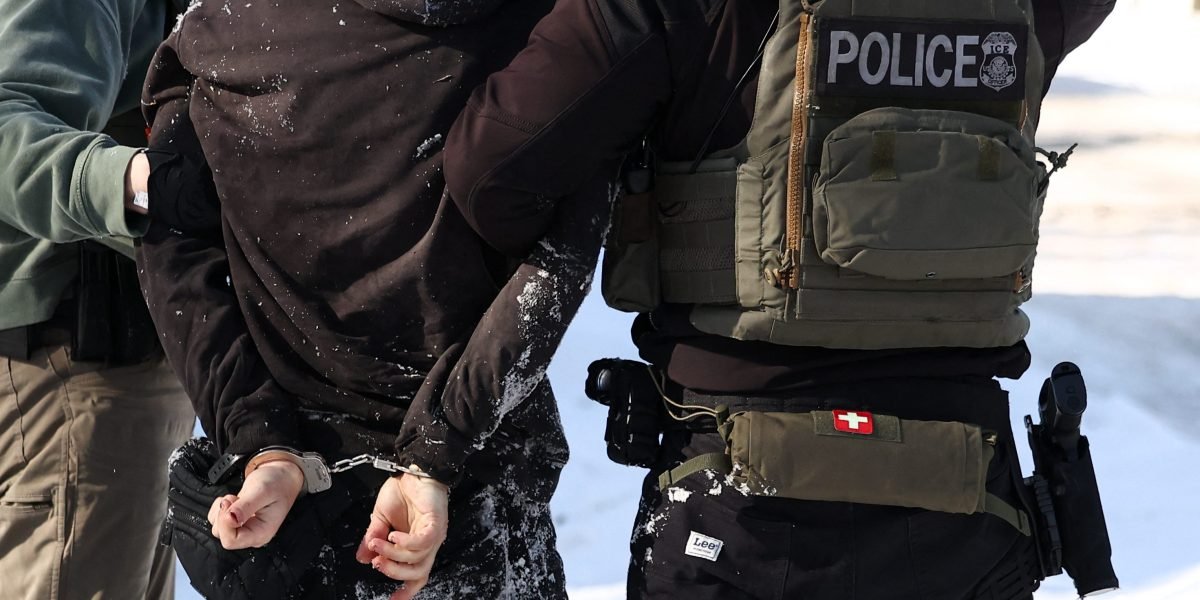
Agents arrested Saari and brought him to the Bishop Henry Whipple Federal Building in Minneapolis, where he was detained for at least six hours before being released without charges.
Reached for comment, ICE referred The Intercept to Customs and Border Protection. Neither CBP nor the Department of Homeland Security responded to requests for comment.
Inside the federal building, Saari said agents shackled his hands and feet, photographed him, scanned his face, and forced him to provide a DNA sample by depressing his tongue and swabbing the inside of his mouth. He said agents denied him access to an attorney, even though they were present elsewhere in the building and in contact with civilians and federal officials that day.
“I asked for an attorney probably a hundred times and was never given one,” Saari said. “I was never told why I was being arrested.”
Then, Saari said, “They took my cell phone and cloned it. They actually told me they did that.”
Saari said agents did not ask him to unlock the device, nor did they provide a warrant, paperwork, or explanation authorizing the search.
“They took my cell phone and cloned it. They actually told me they did that.”
“Every step of this process raises red flags,” said Shauna Kieffer, the vice president of the Minnesota Association of Criminal Defense Lawyers who is now representing Saari. “You don’t get to detain someone without cause, deny them access to counsel, seize their phone, and then search or copy it without a warrant.”
Law enforcement may seize a phone during an arrest, but officers generally cannot access or duplicate its data without judicial authorization, said Nathan Wessler, deputy director of the American Civil Liberties Union’s Speech, Privacy, and Technology Project. He said the only exception involves narrow emergency circumstances, which typically do not apply once both a person and their phone are already in custody.
“Once the phone is secured and the person is secured, it’s very hard to imagine what kind of emergency would justify searching or copying it without a warrant,” Wessler said.
Failure to get a warrant raises serious concerns of violating the Fourth Amendment, Wessler added, pointing to the 2014 Supreme Court case Riley v. California, in which the court found police are generally not allowed to search an arrested person’s cell phone without a specific warrant.
“The government needs a warrant to search or copy the contents of a phone, just as it would need a warrant to look through it,” Wessler said. And that warrant “has to be particularized to the evidence the government actually has probable cause to seek,” he added. “You don’t get a blank check to rummage through someone’s digital life.”
“You don’t get a blank check to rummage through someone’s digital life.”
About seven hours after his arrest, Saari was released into sub-zero temperatures without transportation, unsure of where he was. He said he didn’t know if he remained under investigation, nor whether the government would retain copies of his phone data or DNA sample.
“Finding out that someone who served our country was being denied access to counsel was heartbreaking,” said Kieffer, who was connected with Saari two days after his detention through a colleague. “He should never have been invisible to us.”
While he was in detention, Saari said, agents provided minimal food and water, and detainees with visible injuries did not receive timely medical care.
“I asked for water about a dozen times,” he told The Intercept. “At one point they brought three bottles of water for seven people.”
Saari said detainees had to use their drinking water to clean blood off of their injured peers, which is consistent with accounts from another civilian arrested that day and previously reported by The Intercept.
“There was a man with a golf-ball-sized contusion on his head who didn’t get medical attention,” Saari said. “There was a 70-year-old Marine Corps veteran with a deep gash on his elbow who was bleeding.”
Saari said the treatment he received stood in sharp contrast to how he handled detainees during his own military service, including during combat operations in Iraq.
During one raid in Fallujah, Saari said his unit detained men who surrendered without resistance. After the operation, he said, they reviewed video footage showing the detainees had recently planted an improvised explosive device targeting a U.S. convoy.
Despite the brutality of some operations in Fallujah, where U.S. forces repeatedly killed Iraqi civilians, Saari said his unit restrained, searched, and turned over the detainees without abuse or humiliation.
“We still treated them as humans,” Saari said. “To be treated worse here, at home, than people who had attacked our unit in a war zone, it’s been hard to understand.”